


Raspberries around the world: cultivation, varieties and production
Raspberries are delicate and delicious fruits. They are grown in many regions around the world, where they play an essential role in the food industry, whether consumed fresh or processed into purées, juices or even desserts. With global production exceeding 700,000 tonnes in 2020, raspberries are one of the most popular red fruits around the world. But where do they come from, and how are they grown? We take a look at global raspberry production, with a particular focus on Serbia, a key player in the export of frozen raspberries.
Global raspberry production, a market dominated by nine countries
Raspberry production is dominated by several countries, which together account for more than 80% of global production. These include major players such as Russia, the United States, Poland, Mexico and Serbia. In 2020, these countries contributed to global raspberry production, both for fresh fruit consumption and processed products.

Focus on Serbia, leader in frozen raspberry exports
Serbia is the world’s leading exporter of frozen raspberries. Although the country is not part of the European Union, its exports to the EU are liberalised, enabling strong growth in its raspberry industry. Raspberry farms in Serbia are mainly family-run, with an average size of 0.3 hectares per farm, representing a highly localised agricultural structure.
Serbia has several advantages when it comes to raspberry production:
- A climate and soil that are particularly favourable for growing raspberries.
- A long tradition of growing this fruit, supported by agricultural methods passed down from generation to generation.
Numerous freezing units spread across the country, with around 500 freezing sites, guaranteeing excellent fruit preservation quality.
The raspberry bush: ideal conditions for high-quality cultivation
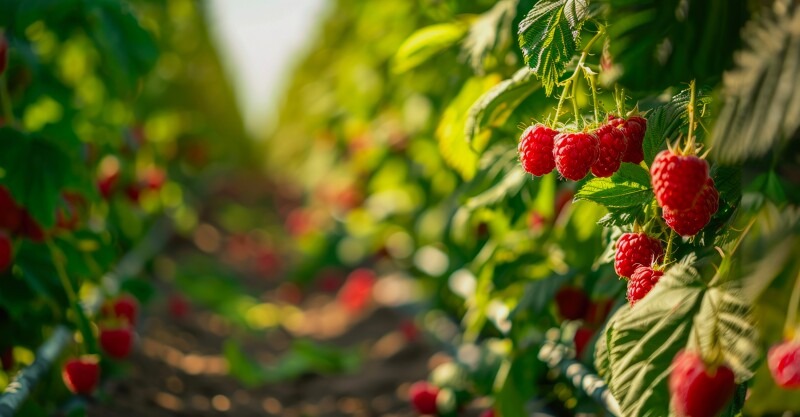
The raspberry bush is a hardy plant that requires specific conditions to ensure fruit quality and productivity. In Serbia, raspberries are grown in areas between 600 and 1,000 metres above sea level. This altitude, combined with hilly terrain, provides a cool, well-ventilated climate, which is essential for preventing moisture build-up and thus the development of fungal diseases. These ideal growing conditions make Serbia a prime location for the production of high-quality raspberries.
A raspberry bush begins to produce fruit after 2 to 3 years and reaches full productivity after 3 years. Although this crop requires some time to adapt, it can produce fruit for around 15 years. Thanks to its longevity, the raspberry bush is a sustainable crop, offering a regular harvest over several years.
Harvesting raspberries is a delicate process, which is done manually, usually between June and July. Due to the fragility of the fruit, it must be done in several passes to pick only the perfectly ripe fruit. This meticulous process ensures that only the best quality fruit is harvested, in order to preserve its flavour and texture. However, recent weather conditions have made harvesting increasingly irregular, making production management more complex and demanding.
To maximise productivity and maintain crop quality, raspberry bushes are trained. This technique promotes good aeration between plants, prevents stem breakage and greatly facilitates harvesting. In addition, raspberry bushes are regularly pruned to remove dead wood and encourage new growth, contributing to the long-term health of the plants. These training and pruning practices are essential to ensure optimal and sustainable raspberry cultivation.

The harvesting and processing of raspberries in Serbia
The process of harvesting and processing raspberries in Serbia is meticulous in order to guarantee the quality of the fruit. Harvesting is done by hand and with great care, as raspberries are very fragile. Here are the main steps in this process:
Pre-cooling
As soon as they are harvested, the raspberries are quickly cooled to preserve their texture and colour.
Deep freezing
After cooling, the fruit is sent to a freezing tunnel at -35°C for approximately 12 hours, an essential process for maintaining the quality of the fruit throughout its processing.
Manual sorting
After freezing, manual sorting is carried out to remove non-compliant fruit.
Packaging
Finally, the fruit is packaged in bags ready for shipment for use in various industrial applications, ranging from purées to desserts and beverages.


Raspberries, a fruit steeped in tradition and innovation
Raspberries, an iconic fruit in many parts of the world, continue to delight with their unique flavour and versatility in cooking. In Serbia, raspberry production and processing are a true craft, supported by family farms and modern freezing techniques. Serbian producers play a key role in the global supply of high-quality raspberries, particularly for European markets.
With growing demand for frozen and processed products, raspberries continue to establish themselves as an essential fruit in the food industry, and their future looks promising.